Hearing aids are a boon to millions of Americans with hearing loss. But as well as they perform, they do have their limitations. They won’t work for all types of hearing loss, and some people find them too uncomfortable to wear or complain of the “occlusion effect” they produce in the ear.
They must be cleaned frequently, their batteries need replacing on a regular basis constant exposure to heat, humidity and earwax buildup in the ear canal makes them prone to damage. For some individuals, implantable hearing devices might be the key to improved communication.
Implantable hearing devices are surgically implanted instruments designed to improve the transmission of sound vibrations by directly stimulating the bones of the middle ear. There are several different types of implantable hearing devices; these include cochlear implants, bone anchored hearing aids and auditory brainstem implants.
Types of Implantable Hearing Devices
Implantable hearing devices work by stimulating the bones of the middle ear (ossicles) rather than amplifying sounds in the ear canal. This strengthens sound vibrations in the inner ear, and enables those with sensorineural hearing loss to be able to communicate.
Implantable hearing devices are less prone to feedback issues that can bedevil those who wear hearing aids, and some devices can be kept in place while a patient bathes and exercises.
Cochlear Implants
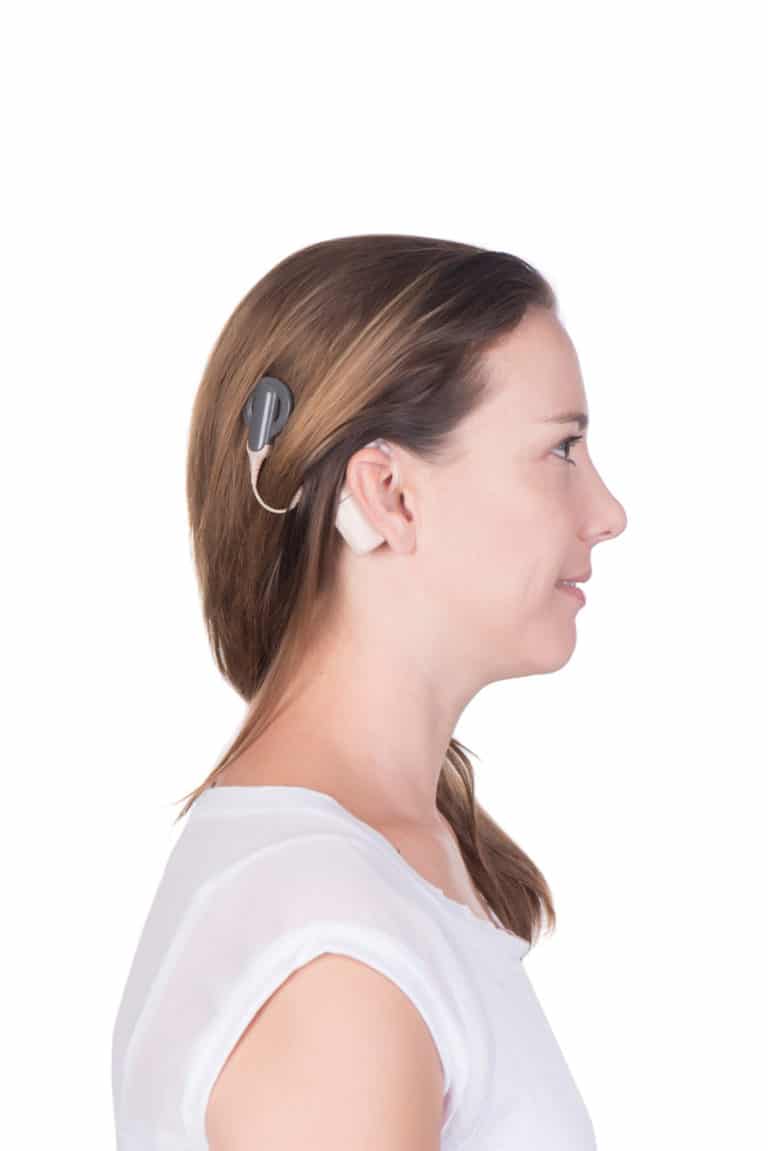
Cochlear implants are devices that are implanted surgically behind the ear. They contain an external portion consisting of a microphone, sound processor and transmitter, and an internal portion that includes a receiver and a group of electrodes.
The microphone picks up sounds in the environment, which are then converted by the sound processor into electronic signals that are sent to the transmitter. The transmitter forwards these signals to the receiver, where they are then passed on to the electrodes. The electrodes stimulate the auditory nerve, which carries the information directly to the brain, where it is interpreted as sound.
Cochlear implants allow those who are profoundly deaf to understand speech and other sounds.
Bone Anchored Hearing Devices
Bone anchored hearing devices consist of a titanium implant, an external abutment and a sound processor. Like cochlear implants, this system bypasses damaged hair cells in the auditory canal and middle ear, transmitting sound vibrations through the external abutment to the titanium implant, which naturally integrates (“ossifies”) with the skull bone over time.
The bones of the skull act as conductors, transmitting these sound vibrations to the inner ear, where the nerve fibers responsible for hearing are stimulated. A bone anchored hearing device is especially useful for patients with conductive hearing loss and single-sided deafness.
ABI
Auditory brainstem implants (ABI) are similar in concept to cochlear implants, but rely on electrodes placed directly on the brainstem that relay electronic signals to the brain. ABIs are less common, usually reserved for individuals whose auditory nerve does not function properly due to disease or trauma.
The majority of cases are related to a rare type of tumor known as neurofibromatosis type II (NF2). These patients have sensorineural hearing loss and, because the auditory nerve is damaged, do not benefit from cochlear implants.
Call Georgia Hearing Center at ENT of Athens at (706) 546-5689 for more information or to schedule an appointment.